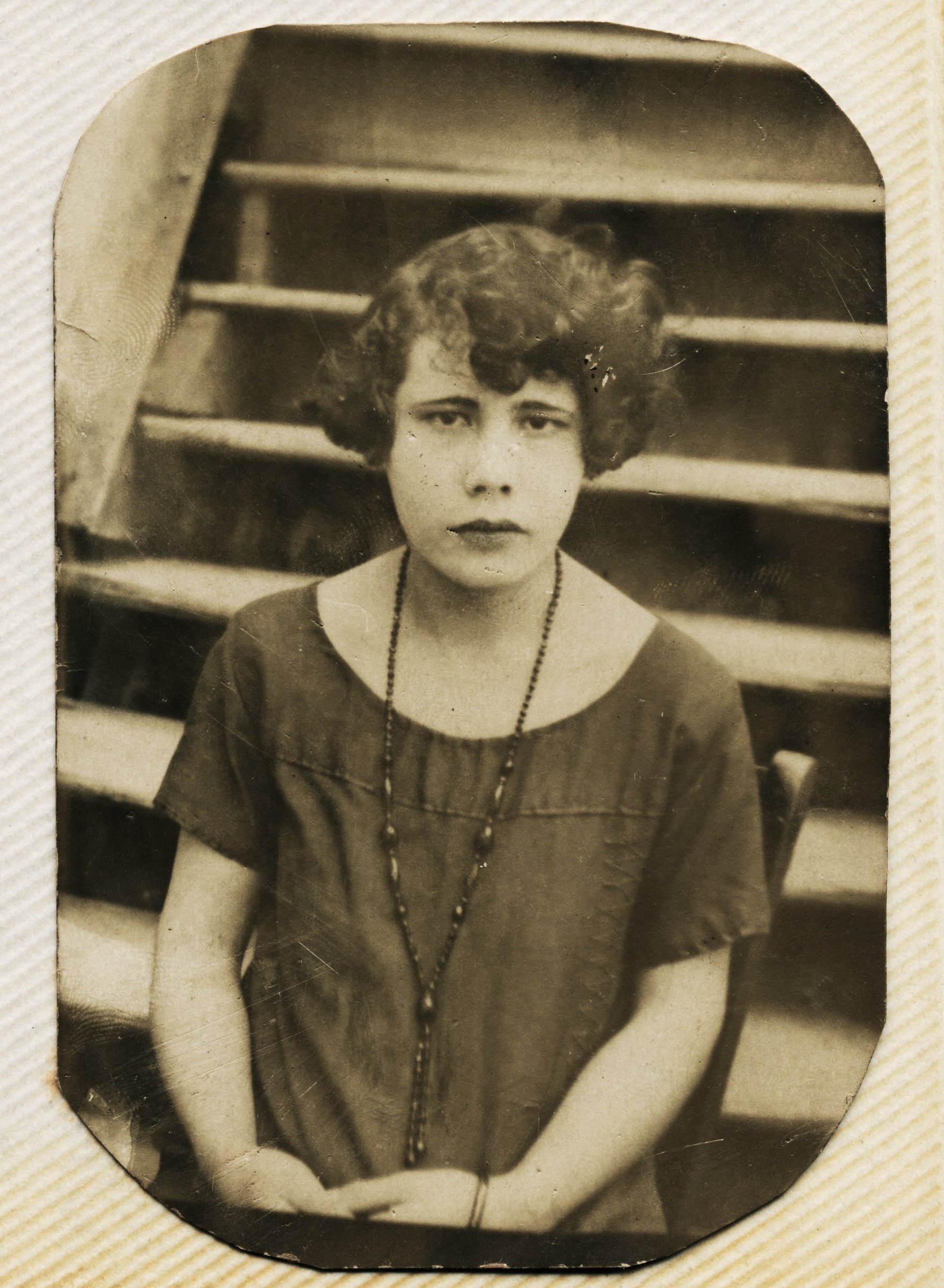
The print is small. About nine centimetres on the long edge, with a scalloped white border and rounded corners, the way studio prints were finished for decades. It has been in a box, then in an album, then in a different box. The surface has a fine crazing across the lower third that catches the light.
I scanned it at twelve hundred dots per inch, which is far more than a print that size warrants, and got back a file large enough to fill a screen with her face alone.
That is where it stopped being a simple task.
What the scan showed
At that magnification the photograph stops being a picture of a person and becomes a record of a surface. You can see the grain. You can see the weave of the paper through the emulsion in the highlights. You can see that the backdrop, which at print size is a soft grey nothing, is painted canvas with a visible seam.
And you can see her face at a scale nobody in 1925 could have seen it, because the technology to look this closely at a nine centimetre print did not exist and there would have been no reason to build it.
I sat with that for a while.
The uneasy part
A studio portrait is a negotiation. You sit still, somebody arranges the light, and what comes out the other end is an image you have agreed to. She agreed to a small print, seen at arm's length, passed around a room. She did not agree to this.
I do not think that makes it wrong. She is not here to be asked, and the alternative is that the print stays in a box and degrades quietly, which is not a more respectful outcome, just a less examined one. But it is worth noticing that a scanner is not a neutral instrument. It does not preserve a photograph. It makes a new one, at a scale the original was never built for, and hands you detail the subject never consented to reveal.
What I actually learned
Almost nothing factual. The scan told me the studio had a seam in its backdrop and that somebody had touched up the eyes slightly, which was standard practice and which I would never have seen at print size.
What it gave me instead was the thing I did not expect, which is that at that size she stops being a photograph of my grandmother and becomes a young woman in an uncomfortable dress, on a particular afternoon, waiting for a man with a plate camera to finish. Twenty-something. Slightly impatient. Not yet anybody's grandmother, and with no idea she would become one.
The small print never showed me that. It could not. At nine centimetres she is a figure in a family story, and the story is the thing you see. Enlarged, the story falls away and what is left is a person having an ordinary bad hour.
I have not decided whether the enlargement is a gain.
The file
It sits on a drive with a plain filename and a date. I have not printed it and I do not intend to. The small print has gone back in the box, which is where it works.
Both versions exist now, which is a thing photographs have only been able to do for about thirty years, and I am not sure anybody has worked out what to do with it yet.
Leave a Reply